Introduction
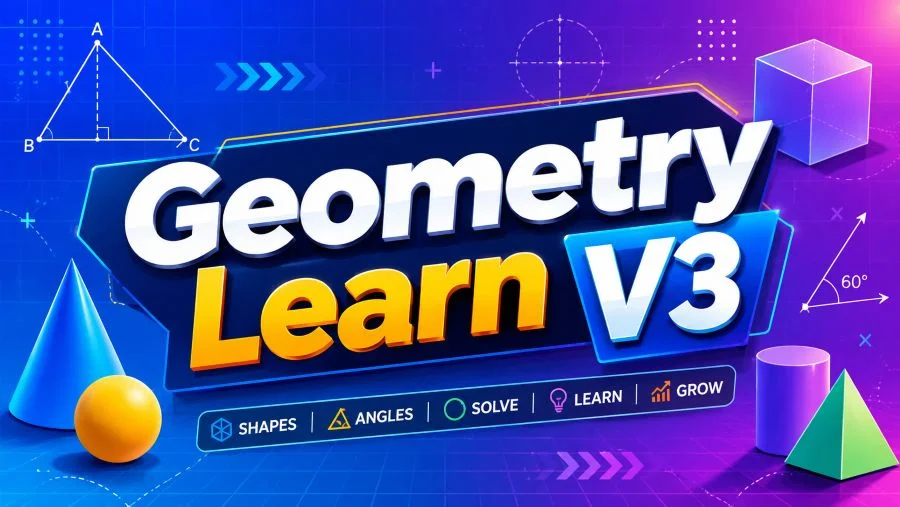
Geometry Learn V3 has emerged as a topic of interest among students, teachers, parents, and lifelong learners seeking effective ways to understand geometry through digital tools. As mathematics education continues to evolve, interactive learning platforms have become increasingly valuable for making complex concepts easier to visualize and understand. Geometry, in particular, benefits greatly from digital technology because shapes, angles, measurements, and spatial relationships can be explored through dynamic diagrams and real-time interaction.
Traditional classroom instruction remains an important foundation for mathematics education, but digital platforms now provide additional opportunities for practice, experimentation, and personalized learning. Whether someone is studying basic geometric shapes, preparing for school examinations, or developing advanced mathematical skills, interactive educational resources can significantly improve understanding and confidence.
Understanding Geometry Learn V3
Geometry Learn V3 generally refers to a modern approach to learning geometry through digital resources and interactive educational tools. Unlike traditional textbooks that rely on static illustrations, interactive geometry platforms allow students to manipulate figures, measure angles, construct shapes, and observe mathematical relationships in real time.
By combining visual learning with hands-on exploration, these platforms make abstract concepts easier to understand. Students are encouraged to experiment, identify patterns, and develop problem-solving skills through active participation rather than passive memorization. This learner-centered approach helps make geometry more engaging and accessible for students of all ages.
The Evolution of Geometry Education
For centuries, Geometry Learn V3 was taught using chalkboards, rulers, compasses, and printed textbooks. While these methods remain valuable, modern technology has introduced new ways to explore mathematical ideas. Interactive software allows students to create geometric constructions instantly, test hypotheses, and visualize transformations that would otherwise require extensive manual drawing.
Digital learning complements traditional instruction by providing immediate feedback and unlimited opportunities for practice. Technology has made geometry more dynamic than ever before. Learning geometry also strengthens logical reasoning, visualization, and analytical thinking—skills that extend far beyond mathematics classrooms. Geometry is one of the fundamental branches of mathematics. It studies shapes, sizes, angles, distances, and spatial relationships.
Interactive Learning Experiences
One of the greatest strengths of Geometry Learn V3 is its emphasis on interaction. Students are no longer limited to viewing completed diagrams. Instead, they actively build geometric figures, move points, adjust measurements, and observe how relationships change. This exploratory process encourages deeper understanding because learners discover mathematical principles through experimentation.
Interactive experiences also improve long-term retention by engaging multiple learning styles simultaneously. Visual, kinesthetic, and logical learners all benefit from this approach. Even sports involve geometric concepts related to movement and positioning. Understanding geometry prepares students for numerous future careers. Visualization strengthens conceptual understanding significantly.
Learning Basic Geometric Shapes
Geometry Learn V3 begins with simple shapes. Students first explore points, lines, line segments, rays, and angles. They then progress to polygons such as triangles, squares, rectangles, pentagons, and hexagons. Circles introduce concepts including radius, diameter, circumference, and area. Interactive platforms allow students to construct these shapes while observing their defining properties. Understanding these foundations prepares learners for more advanced topics.
Angles represent one of geometry’s most important concepts. Students learn to identify acute, right, obtuse, straight, reflex, and full angles. Digital geometry tools often include measurement features that instantly display angle values. This immediate feedback helps learners recognize relationships between different angle types. Students can also investigate complementary, supplementary, vertical, and corresponding angles through interactive diagrams.
Triangles and Their Properties
Triangles occupy a central position within geometry education. Students classify triangles according to side lengths and angle measurements. Geometry Learn V3 They study equilateral, isosceles, and scalene triangles as well as right, acute, and obtuse triangles. Interactive platforms enable learners to modify triangle dimensions while observing how angles and side lengths relate.
Concepts such as congruence, similarity, and the Pythagorean Theorem become easier to understand through visual exploration. Personalized learning encourages confidence because learners can spend additional time mastering challenging topics without feeling pressured by classroom schedules. Technology enhances teaching effectiveness without replacing the important role of classroom educators.
Circles and Curved Figures
Circles introduce students to additional Geometry Learn V3 relationships. Key concepts include radius, diameter, circumference, chords, tangents, arcs, sectors, and central angles. Interactive software allows learners to manipulate circles dynamically while measuring distances and observing proportional relationships. These visual demonstrations simplify concepts that often appear abstract in printed textbooks.
Students gain confidence through repeated experimentation. Three-dimensional exploration enhances spatial reasoning. Coordinate geometry also prepares students for higher-level mathematics. Understanding volume, surface area, and spatial relationships becomes much easier when students can examine models dynamically rather than relying solely on printed illustrations.
Coordinate Geometry
Coordinate geometry combines algebra with geometric reasoning. Students locate points on coordinate planes using ordered pairs. They calculate distances, determine slopes, identify midpoints, and graph equations. Digital platforms frequently include interactive coordinate grids where students can drag points and instantly observe mathematical changes. This integration strengthens understanding across multiple mathematical disciplines.
Geometry Learn V3 extends beyond flat figures into three-dimensional space. Students study cubes, spheres, cylinders, cones, pyramids, prisms, and other solid objects. Interactive visualization tools allow learners to rotate shapes from different perspectives.
Real-World Applications
Geometry Learn V3 appears throughout everyday life. Architects design buildings using geometric principles. Engineers calculate structural stability. Graphic designers create visual layouts. Artists apply symmetry and perspective. Computer programmers develop animations and video games using geometric calculations. Surveyors measure land boundaries.
Every student learns at a different pace. Geometry Learn V3Interactive educational platforms accommodate individual learning needs by allowing users to repeat lessons, practice difficult concepts, and progress according to personal ability. Immediate feedback helps students identify mistakes while reinforcing correct solutions.
Advantages of Interactive Mathematics
Interactive mathematics offers numerous educational benefits. Geometry Learn V3 Students become more actively engaged. Visual demonstrations improve comprehension. Immediate feedback accelerates learning. Experimentation encourages curiosity. Mistakes become valuable learning opportunities. Repeated practice strengthens long-term retention. Technology also increases accessibility by allowing students to learn from home, school, or virtually any location with internet access.
These advantages contribute to improved mathematics education. Digital geometry tools also benefit educators. Teachers can demonstrate concepts visually during lessons while creating interactive classroom activities. Assignments may include dynamic constructions rather than static worksheets. Many educational platforms provide assessment tools that track student progress and identify areas requiring additional instruction.
Developing Problem-Solving Skills
Geometry involves much more than memorizing formulas. Students learn how to analyze information, recognize patterns, develop logical arguments, and justify conclusions. Interactive learning environments encourage exploration before formal proof. This approach builds critical thinking skills applicable across science, engineering, technology, finance, and many other disciplines.
Problem-solving remains one of the most valuable outcomes of mathematics education. Geometry Learn V3 reflects this exciting direction, demonstrating how innovation can make one of mathematics’ oldest disciplines more interactive and inspiring than ever before.
The Future of Geometry Education
Educational technology continues advancing rapidly. Artificial intelligence, augmented reality, virtual reality, adaptive learning systems, and intelligent tutoring platforms promise even more personalized mathematics instruction. Future geometry applications may allow students to explore mathematical concepts through immersive three-dimensional environments and real-time collaboration with classmates worldwide.
As technology evolves, Geometry Learn V3 education will likely become even more engaging, accessible, and effective for learners of all ages. As educational technology continues to advance, digital geometry tools will play an increasingly significant role in helping students build confidence, strengthen mathematical understanding, and prepare for future academic and professional success.
Conclusion
Geometry Learn V3 represents the modern evolution of mathematics education by combining traditional geometric principles with interactive digital technology. Through dynamic diagrams, real-time experimentation, personalized learning experiences, and visual exploration, students gain a deeper understanding of shapes, angles, measurements, and spatial relationships.
Geometry remains one of the most important areas of mathematics because it develops logical reasoning, critical thinking, and practical problem-solving skills that apply across numerous academic subjects and professional careers. Interactive educational platforms enhance these benefits by making learning more engaging, accessible, and adaptable to individual needs.
You May Also Read: Brasssmile com